

Unmanned Surface Vessel · Maritime Domain Awareness
GROM
Autonomous Maritime ISR & Strike Platform
A modular, low-cost autonomous surface vessel for persistent maritime domain awareness and operator-authorized precision strike. Simple. Effective. Mass-produced. Container-sized.
Design doctrine
Simple
Commercial propulsion, proven components, one hull. Fewer parts to fail, fewer parts to certify, fewer parts to sustain in the field.
Effective
Persistent surveillance and ISR coverage with a human in authority over every active task. Capability where it matters, nothing where it doesn't.
Mass-produced
Engineered for production rate, not prototype theatre. Standardized components and repeatable builds keep unit cost low and fleets growing.
Container-sized
The entire platform ships in a standard 20 ft ISO container. If a truck, train, or ship can carry a container, it can carry GROM.
GROM extends the reach of maritime forces without extending their crews. From persistent ISR patrol to operator-authorized precision strike, one platform re-roles across the mission, and a human holds authority over every active task.
Where others build exquisite platforms in small numbers, Hussar builds numbers. Maritime domain awareness is a coverage problem, and coverage is won by fleets that are affordable, replaceable, and everywhere at once.
ClassAutonomous Surface Vessel
Mission setISR · MDA · Strike
ControlHuman-in-the-loop
Logistics20 ft container
Two Paths, One Platform
Hussar Autonomous Defense Systems was founded by two childhood friends who took very different paths and converged on the same conviction. Watching the drone boom reshape war on land and in the air, they saw a glaring void at sea. Inspired by the lean, secretive ethos of the legendary Skunk Works, they set out to fill it with small, efficient, mass-producible naval drones.
Where others build exquisite platforms in small numbers, Hussar builds numbers, and backs them with a founding team that has actually shipped hardware to demanding customers.

A Polish winged hussar, outlined in carbon fiber, the material GROM is built from
The name
The company takes its identity from the Winged Hussars, the Polish heavy cavalry whose smaller, faster, superbly disciplined force broke the vastly larger Ottoman army at the Battle of Vienna in 1683. That is the thesis of the whole company in a single image: a small, agile, well-engineered force defeating one far larger and more expensive, exactly what a low-cost autonomous vessel represents against a multi-million-dollar warship.
GROM, Polish for thunder, carries the name of Poland’s modern special-forces unit, heirs to that hussar tradition. The crest renders a winged hussar in carbon fiber: the material the platform is built from, and the emblem of what the company stands for.
Co-founder · United States operations
Christopher
A third-generation military-electronics supplier, Christopher brings a family lineage of routinely delivering to U.S. government and military branches under rigorous ISO standards and compliance regimes. He leads the U.S. entity, running manufacturing and distribution for the domestic and allied market.
Co-founder · European operations · Poland
Daniel
Daniel spent two decades at the sharp end of motorsport, building deep expertise in mechanical systems, composites, and precision machining. He designed the original drone concept and brought it to Christopher to turn into a defense-industry venture. He leads the European market from Poland.
Obsessed with quality, lean management, and scaling production. Proudly built in the USA and Poland
Platform Specifications
Technical datasheet
Every dimension of GROM is disciplined by one constraint: the platform, cradle, and ground support equipment must fit and ship inside a standard 20 ft ISO container. That constraint is not a limitation. It is the logistics concept.
Detailed performance figures, payload interface documentation, and configuration options are available to qualified government and institutional parties under NDA.
Length overall< 5.9 m, container envelope
Beam overall< 2.3 m, container envelope
StructureDry carbon-fiber composite
PowertrainCommercial marine propulsion
EnduranceLong-range patrol · mission dependent
CrewAutonomous · human-in-the-loop
C2 & navigationEncrypted SATCOM architecture
PayloadModular ISR sensor fit
TransportStandard 20 ft ISO container
Operating domainSurface · littoral & offshore
Platform Capabilities
Subsystem register
AUT
Human-in-the-loop autonomy
Mission-configurable autonomy that always operates under operator authorization for any active tasking. The vessel handles navigation and station-keeping; a person holds decision authority.
HUL
Dry carbon-fiber composite hull
Durable composite construction for low weight, high endurance, and a reduced radar cross-section, built to run long and stay hard to find.
PRP
High-performance marine propulsion
Commercially available propulsion, integrated and tuned for long-range patrol endurance. Proven components keep unit cost low and sustainment simple.
PAY
Modular mission payload
Standardized payload interfaces accept mission-specific ISR sensor fits, including electro-optical, radar, and communications packages, configured to the customer's requirement without structural redesign.
EFX
Precision maritime strike
Configurable as a one-way effector for precision kinetic effects against surface targets. Every engagement requires positive human authorization. Meaningful human control is architectural, not optional.
C2
Resilient satellite-linked C2
Encrypted, satellite-linked command and navigation architecture designed to hold connectivity in contested and degraded environments, and to interface with existing command-and-control systems.
LOG
Container-native logistics
Compatible with a standard 20 ft shipping container for deployment by road, rail, or sealift, and for straightforward export handling.
IND
Allied industrial base
Engineered in Poland for EU and NATO allied maritime security programs; engineered in the USA for domestic maritime and border-security applications.
Mission Profiles
ISR · MDA · EffectsMDA
Coastal & EEZ surveillance
Persistent patrol of territorial waters and exclusive economic zones, extending coverage far beyond crewed patrol capacity.
MDA
Critical infrastructure monitoring
Sustained observation of subsea cables, pipelines, offshore energy assets, and port approaches.
ISR
Intelligence, surveillance & reconnaissance
Forward sensing in littoral environments, feeding actionable intelligence to commanders in near real time.
Border
Maritime & riverine border security
Detection and tracking of illicit trafficking, smuggling, and unauthorized crossings along coastal and river borders, including shallow, muddy frontier waters unsafe to patrol on foot.
Effects
Precision maritime strike
Operator-authorized terminal engagement of surface targets as an attritable one-way effector, sensor to effector on a single hull.
Ports
Port & harbor security
Continuous customs and border-control watch over port waters, screening vessels on entry and berthing, at a fraction of the fuel and crew cost of manned patrol boats.

Ports & customs
The harbor watch that never sleeps
For border control and customs authorities, GROM stands a continuous watch over port waters, monitoring approaches, screening vessels entering and berthing, and inspecting hulls and waterlines around the clock, in weather that would keep a crewed patrol boat tied up.
Constant automated surveillance replaces the fuel, crew hours, and wear of dispatching a manned boat for every check. One vessel can hold the picture continuously, freeing officers to act on what it finds rather than spending shifts looking.
Lower fuelvs. repeated manned sorties
Fewer crew hoursofficers redeployed to response
All-weatherpersistent watch, day or night
Where crews can't go
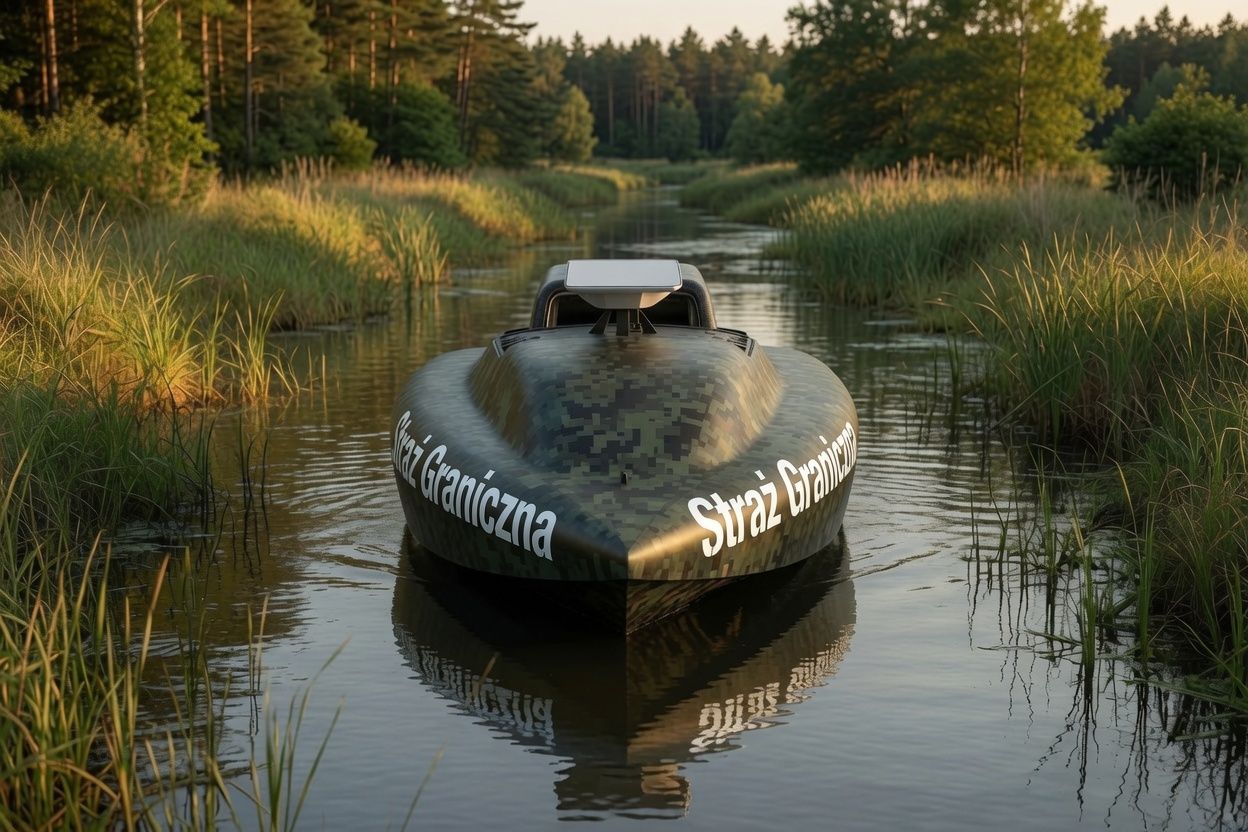
Built for the muddy frontier
Some of the hardest borders to hold are not open sea but shallow rivers, marshes, and bogs, terrain where a crewed boat runs aground and a dismounted patrol can sink in soft mud. GROM's low-profile, shallow-draft hull was made for exactly this ground.
For border-guard services, it patrols narrow frontier waterways continuously, detecting crossings and tracking movement along the line. It puts a persistent, expendable sensor where it is needed without putting a person in the mud, day or night.
Livery shown is an illustrative concept and does not represent an existing deployment or endorsement.


From Container to Coverage
Operational lifecycle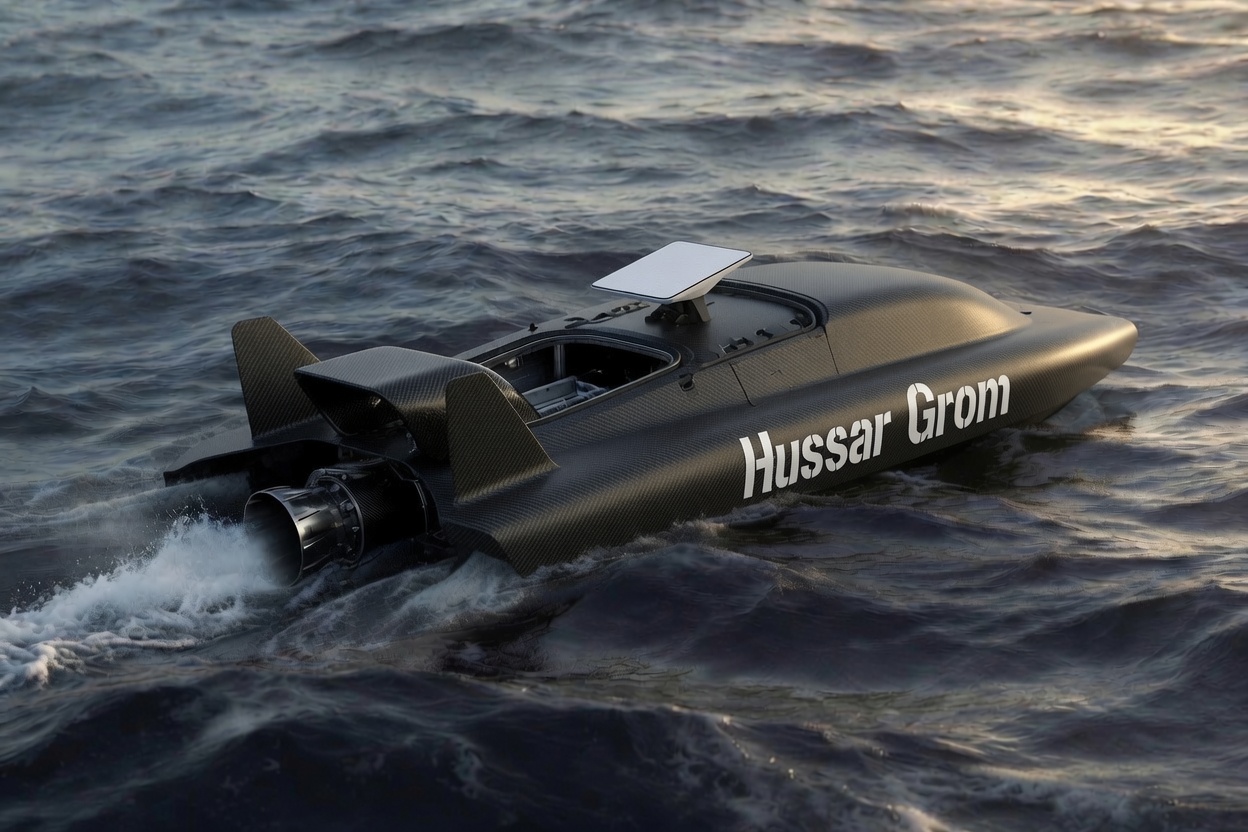
01 · Deploy
Ship it like cargo
GROM travels the way the world's freight travels: on its own off-road trailer, stowed as one unit inside a standard 20 ft ISO container, moved by truck, rail, or sealift with no specialist handling equipment and no complex preparation.
From container to water, the trailer itself becomes the boat ramp. A small team backs it down the slope and the vessel deploys directly into the water. Connectivity is established over the encrypted satellite link and the platform transitions to mission tasking under operator authorization.
C2 interfaceExisting command systems
Payload interfaceStandardized · modular
Data linkEncrypted SATCOM
TeamingCrewed–uncrewed
02 · Integrate
Join the force, don't replace it
GROM is designed to plug into existing maritime command-and-control networks and operate alongside crewed vessels, as a sensor node in a wider system, not an island.
Standardized payload interfaces let customers integrate their preferred sensor and communications packages without redesigning the platform.
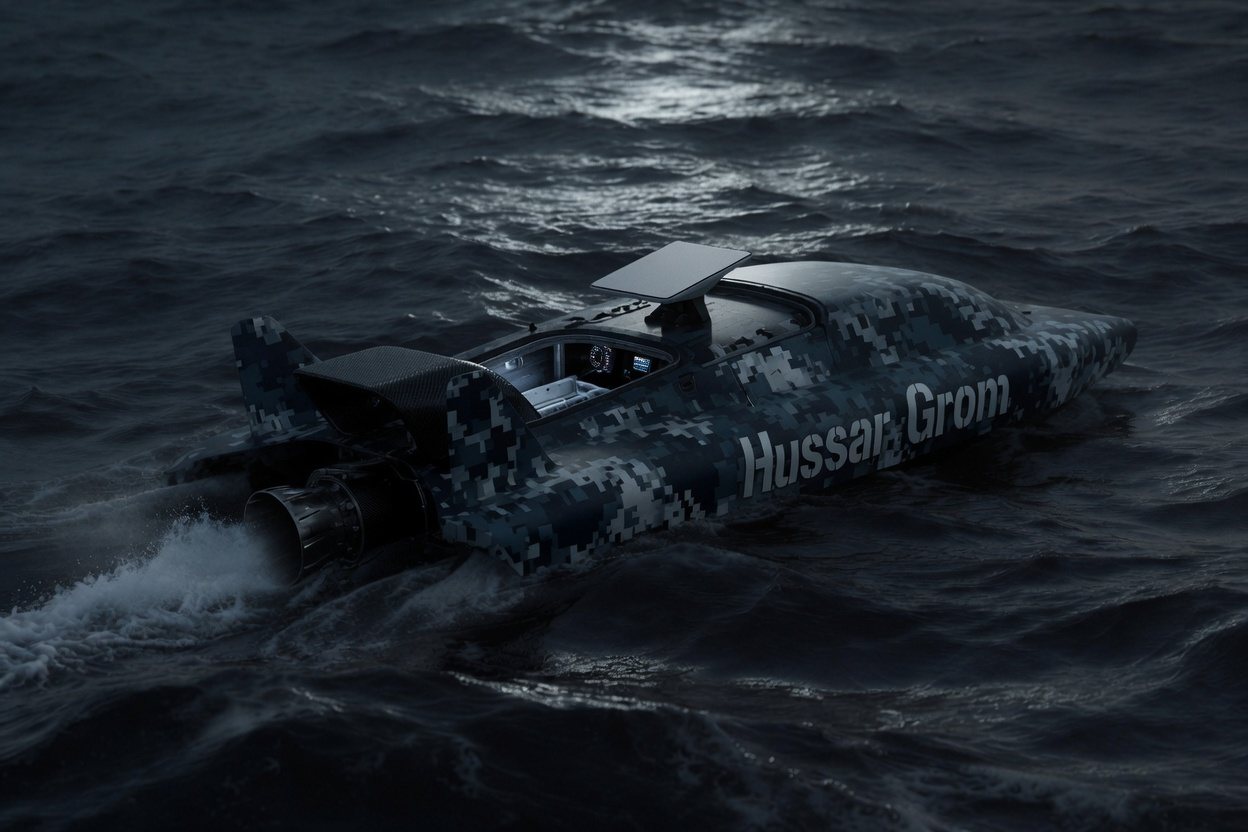
03 · Operate
Patrol longer, risk no one
On station, GROM handles navigation, station-keeping, and route execution autonomously while streaming surveillance data back over the encrypted link. When tasked as an effector, engagement requires positive human authorization. Accountability is built into the architecture, not bolted on.
The low-signature composite hull and long-endurance propulsion keep the platform on patrol around the clock, through darkness and low light, where crewed assets cannot afford to linger.
Production modelSerial · high rate
ComponentsCommercial · standardized
Unit economicsLow cost · replaceable
Fleet conceptDistributed mass at sea
04 · Scale
Coverage is a numbers game
One GROM is a sensor. A fleet of GROMs is maritime domain awareness. The platform is engineered for serial production from commercially available components, so fleets grow with budgets, not against them.
Standardized parts simplify maintenance and sustainment, and attrition of a single low-cost vessel never means the loss of the mission.
One Trailer. Three Jobs.
Integrated deployment systemThe same cradle that secures GROM for container transport launches it straight into the water. GROM ships in its own off-road-capable trailer
No dedicated launch equipment, no crane, no port infrastructure. The trailer is the shipping jig, the road transport, and the boat ramp in a single unit. Hook it to any suitable truck and go, from a container yard to the waterline, with the vehicles a customer already owns.


Role 01 · Stow
Shipping jig
The trailer doubles as the vessel's shipping cradle, securing GROM for transport inside a standard 20 ft ISO container. The whole system moves as air, sea, rail, or road freight.
Role 02 · Tow
Off-road transport
Off-road-capable running gear lets the unit be towed by any suitable truck, from paved highway to unimproved coastline, with no specialist transporter required.
Role 03 · Launch
Boat trailer
At the water's edge the same trailer becomes a conventional boat ramp. Back it down the slope and GROM deploys directly into the water. Recovery is the reverse.
Configurations
Finish & operating conditions

Domestic · law enforcement
Patrol the harbor your city depends on
For police harbor units, port authorities, and customs and border agencies, GROM extends waterway patrol across busy urban harbors, watching bridges, ferry terminals, cruise berths, and shipping channels that a crewed launch can only visit one at a time.
A persistent, low-cost surface vessel holds surveillance on high-traffic waters through the night and in poor conditions, screening vessels and flagging anomalies for officers to act on, without the fuel bill and crew rotation of running a manned patrol boat around the clock.
Livery shown is an illustrative concept and does not represent an existing deployment or endorsement.
Program & Investment Case
For agencies & institutional partnersCost discipline
Commercial supply chain
GROM is built from commercially available marine components integrated into a purpose-designed composite hull. No bespoke propulsion programs, no exotic suppliers, just a supply chain that already exists, at prices markets already set.
Production rate
Designed to be built in numbers
Manufacturability drives engineering decisions. Repeatable composite processes and standardized assemblies mean production scales with demand, and per-unit cost falls as the fleet grows.
Market access
Dual allied footprint
Polish engineering serves EU and NATO allied maritime security programs; US engineering serves domestic maritime and border-security applications. Container-based logistics support export flexibility across both markets.
Two Programs, One Platform
Engineering & supplyPoland · EU / NATO
Allied maritime security
Engineered in Poland for EU and NATO allied maritime security programs, including border-guard patrol of frontier rivers and wetlands, with container-based logistics built for export flexibility across the alliance, from the Baltic to the Black Sea.
United States · Domestic
Maritime & border security
Engineered in the USA for domestic maritime and border-security applications, from federal border and customs agencies to police harbor units, supporting persistent coastal and harbor surveillance at low unit cost.
Put persistent eyes on the water.
For program briefings, technical documentation under NDA, or R&D partnership and funding inquiries, contact the Hussar Autonomous Defense Systems office for your region.
United States
Hussar Autonomous Defense Systems LLC
- Office
- New York, United States
- Focus
- Domestic maritime & border security
- USA@hussarads.com
Poland · EU / NATO
Hussar Autonomous Defense Systems sp. z o.o.
- Office
- Poland
- Focus
- EU & NATO allied maritime security
- Europe@hussarads.com
Hussar Autonomous Defense Systems LLC (New York) and Hussar Autonomous Defense Systems sp. z o.o. (Poland) are the group's two engineering and contracting entities, serving the United States and EU/NATO markets respectively.